
Visit to Pecorama and Peco Factory Tour
24 September 2025
On Wednesday, 24 September, a group of us embarked on a much-anticipated visit to Pecorama and the Peco Factory at Beer. This trip was arranged following a conversation at last year’s Railwells exhibition with Steve Haynes, the Peco Sales Manager, who kindly provided contact details for Derek Boswell, responsible for organising factory tours. After discussions with Derek, we learned that tours are generally limited to 12 people, split into two groups of six. However, after some negotiation, we were able to increase our group size to 24 by scheduling one tour in the morning and another in the afternoon. Although our initial plan had been to visit in June, the installation of new systems at the factory required us to reschedule for September.
Travelling to Beer
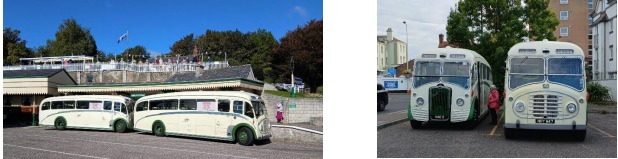
Fraternity member Mike Walker generously agreed to provide transport for the group, surprising us at Wells bus station with two early 1950s Bristol coaches. These classic vehicles, NAE 3 (a Bristol L6B from 1950) and NHY 947 (a LWL6B from 1951), were originally used on Bristol Greyhound express services. While similar in appearance, the 1951 coach features a redesigned front with a concealed radiator and is 6 inches wider than its predecessor—a difference that became more apparent as we navigated the narrow country lanes of Devon, squeezing past oncoming traffic.
Arrival and Welcome
We enjoyed fine, sunny autumn weather for our journey. Despite a few delays due to roadworks, we arrived at Beer just ten minutes behind schedule, ready for the first factory tour before the lunchtime break at 12:15. Derek Boswell and his wife Julia, who also works for Peco, welcomed us warmly. We were invited into the Pullman car Orion for teas and coffees, where we received a brief history of the company and a safety briefing. The first group then set off on the factory tour while the rest of us explored the beautifully landscaped grounds and took a ride on the 7½ inch gauge Beer Heights Light Railway.
The Factory Tour
As lunchtime approached, the morning group returned, enthusiastic about what they had seen. My wife Jacky and I joined the afternoon tour. Photography is not permitted inside the factory, so we donned high-visibility ‘visitor’ waistcoats and split into two groups of six. Julia Boswell led us into the original building erected by Peco in the early 1970s. Today, a glazed screen along the north side houses the design department, where work is now carried out on computers. We were shown a 3D CAD drawing of an N-gauge wagon, illustrating how individual components can be visualised and assessed for manufacturability.
Opposite the corridor, behind glass screens, is the tool room. Tools are now produced using CAD images and electric arc erosion. Examining one of these robust metal tools, we could appreciate the intricate details, such as the ‘wood grain’ effect on the sleepers. Some production processes also take place in this building. Laser cutting of wooden kits produced a faint scent of burning wood, while another machine precisely cut short pieces from a large coil of nickel silver rail imported from Germany, forming check rails and point blades. Production of Peco Streamline flexible track was underway, with the sleeper base—comprising three sections—placed on a jig and inserted into a machine where the rail was drawn into position. Last year, the factory produced over 150 miles of flexible track in various scales and types, exporting to 35 countries.
At the building’s far end, two spray booths were in operation. Through the glass, we saw a painter using an airbrush to apply the base colour to N-gauge wagons. We then moved across the yard to the mould room, where a faint smell of burning plastic greeted us. Plastic pellets are heated and injected into the tools. For points, fixed rail components such as check rails are set in place before the plastic is injected. Notably, the type of plastic used for points differs from that used for flexible track.
Our next stop was a building further up in the gardens, formerly the Play Station children’s indoor play area, now converted for production. Here, we saw the moving parts being added to a point and the wiring attached underneath. Electrical connections are made by inserting small metal pellets and electric welding the wires. Each completed point is electrically tested before being packed in the familiar Peco boxes. Assembly was also taking place for the recently introduced 009 narrow gauge carriages, where sprues of separate roof and side parts cleverly wrap around the chassis and ends to clip into place without the need for glue. The final process we observed was the application of fine details. Rather than using transfers, an inkjet or ink painting process is employed to spray even the tiniest lettering and numbers onto N-gauge wagons.
Throughout the tour, the staff were helpful and eager to explain their work. We learned that the factory is not arranged as a traditional assembly line; instead, batch production is used to accommodate the broad range of Peco products. Peco also operates another factory at Buckfastleigh for the production of Ratio, Wills, and Parkside kits.
After the Factory Tour
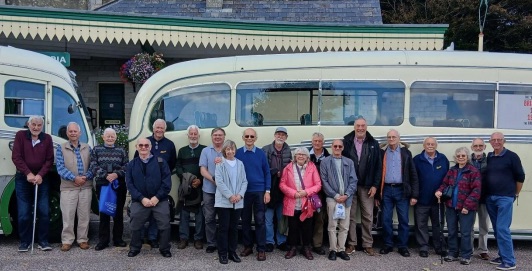
After taking a group photograph, we bid farewell to Derek and Julia and made the short journey to Seaton. With the coaches parked opposite the modern Seaton Tram station, some of us quickly boarded the 16:00 tram departure. The scenic half-hour journey ran alongside the river Axe and its nature reserves. Those on the top deck enjoyed the views despite a cool breeze and were grateful for the dry, sunny weather. At Colyford, the tramway’s terminus, we were delighted to find the tearoom still open and took the opportunity for a cup of tea before returning to Seaton and setting off for home. We arrived back in Wells at 19:40.